
From the desk of a veteran writing consultant, everyone thinks that they are not a very good writer, literally everyone. Sometimes even I do. Without fail, I have at least one consultation a week with a student who sits down and the first thing they say is, “this is probably really bad” before I have a chance to read the writing they have presented.
This has always puzzled me. Why do students automatically assume that they are poor writers? Why do students have no confidence in their own writing abilities?
Part of me is led to believe that people have no faith in their writing skills because of negative professor feedback or a bad critique in class, but that cannot be the case for every student. A lot of students, even English majors, will go on and on about how terrible an essay they wrote was just to get an A on the assignment. It is not just English majors either. Psychology majors worry about case studies; Chemistry and Biology majors worry about lab reports; Creative Writing majors worry about their short stories or poems.
Every discipline gets self conscious about their own kind of writing and I want to explore why that might be and a strategy to combat this phenomenon.
Going into a writing assignment convinced that you have no skill is no way to do it (even though I do that all of the time). Having confidence in your work makes it more fun and often more rewarding.
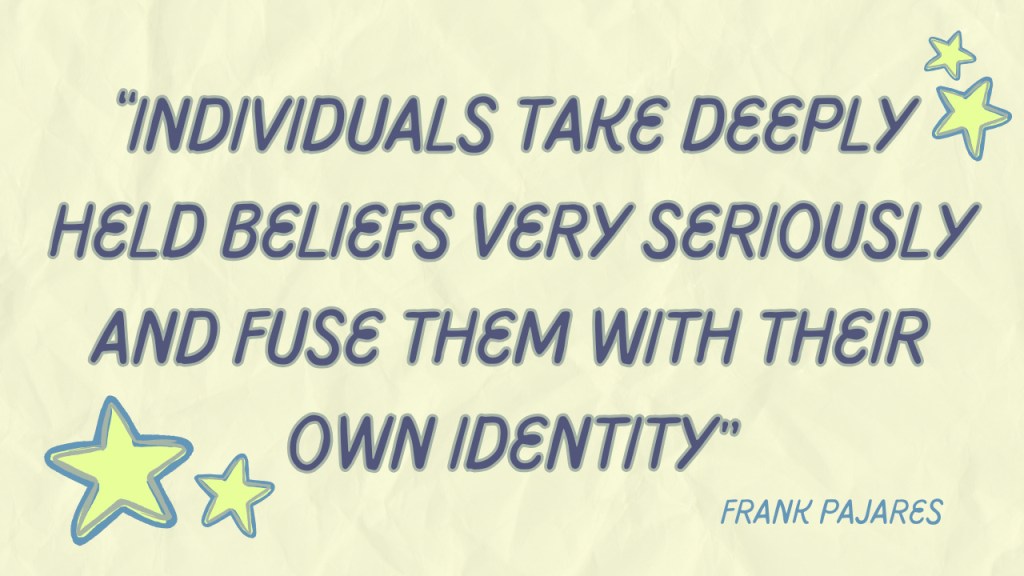
The mindset of a student can affect their quality of work more than most realize. Often the negative beliefs, “in part determine the expectations” of a piece of writing (Pajares 314). Looking at a psychological study of undergraduate students in a writing course, “writing apprehension of [the] participants proved resilient and remained unchanged over the term” (Pajares 325). Even after completing assignment after assignment, the students were apprehensive to the writing process as a whole. To me, this stems from the association of writing and grades in education. Obviously essays or other writing-based projects are expected in college, but that leads to a connection between writing and stress. The constant stress of having to write to be judged on how well you produce content could be a cause of the lack of confidence that I have seen in the Writing Center. A lot of times, “individuals take deeply held beliefs very seriously and fuse them with their own identity,” meaning that if you believe you are a poor writer then you present yourself as one even if that is not truly the case (Pajares 326).
One way to give a writer some major confidence is by reading their work yourself and collaborating together. As a Writing Center consultant, when students come in saying they are bad writers, that is usually code for, “I don’t know what I am doing and want someone else to give me feedback.” Feedback and collaboration are so incredibly important to the writing process and building confidence, but this step often does not take place in academic settings, especially undergraduate ones. When students discuss with one another or their professors they are able to clarify “how they felt and why” about their writing, which is “a realization that may not have come from working alone” (Greiner 57).
Being able to map out ideas or talk through paragraphs with another person can help alleviate stress and the feeling that a writing assignment is all on one person’s shoulders. That other person could be a classmate, a friend, or even a professor (they have office hours for a reason). Either way, being able to verbally express the thoughts in a piece of writing is half the battle.
All in all, I think I have come to the discovery that students are not nearly as bad of writers as they think they are. Undergrads, including myself, are champions at underestimating their competence (Pajares 327). It is often the case of a confidence issue, rather than a skill issue. Good writing comes with practice, lots and lots of practice. There is no such thing as a bad writer, just an inexperienced and unconfident one.
-Mary Jackson Kirk

SOURCES
Greiner, Angelia, and Vicki Collet. “We Should Do This All Year!: Confidence through Collaborative Writing.” English Journal, High school edition, vol. 110, no. 6, 2021, pp. 52–59, https://doi.org/10.58680/ej202131314.
Pajares, Frank. “Inviting Self-Efficacy: The Role of Invitations in the Development of Confidence and Competence in Writing.” Journal of Invitational Theory and Practice, vol. 3, no. 1, 2022, https://doi.org/10.26522/jitp.v3i1.3765.
This post is re-blogged from MJ‘s senior capstone substack, which you can find at https://maryjacksonkirk.substack.com


 Writing at Wofford
Leave a comment